Sludge is a solid waste generated during wastewater treatment, containing complex components such as organic matter, heavy metals, and pathogens. If not properly handled, it can easily cause secondary pollution. With the acceleration of urbanization and the improvement of environmental protection requirements, efficient sludge resource recovery treatment technologies have become a research hotspot. As a new type of thermochemical conversion technology, sludge carbonization technology converts sludge into biochar, gas, and liquid products under high-temperature oxygen-free conditions. It has the advantages of volume reduction, stabilization, harmlessness, and resource utilization, and has received widespread attention in recent years.Sludge carbonization is the process of heating sludge in an oxygen-free or anoxic environment to induce pyrolysis, polycondensation, and carbonization reactions of organic matter, producing carbon-rich solid products (biochar) and releasing combustible gas (oil).According to carbonization temperature, technologies can be classified into low-temperature carbonization (200–400℃), which has low energy consumption and retains more organic matter but has a long treatment cycle; medium-temperature carbonization (400–600℃), which has fast reaction rate, high carbonization efficiency, and strong product stability; and high-temperature carbonization (600–800℃), which achieves deep decomposition of organic matter and significant reduction effects, but is technically complex, with high equipment investment and energy consumption.III. Development History of International Carbonization Technology(1) Initial Stage (Before 2000)- Research focused on sludge incineration and landfill, with carbonization technology still in the laboratory exploration phase.
- Japan took the lead in sludge pyrolysis research, verifying the potential of carbonized products in the agricultural field.
(2) Technology breakthrough period (2000–2015)- European countries (such as Germany and Sweden) promoted pilot projects and optimized reactor design.
- Research focused on energy balance, heavy metal immobilization, and expansion of product application scenarios.
(3) Commercialization and Promotion Period (2015-Present)- Emerging economies such as China and South Korea accelerated the deployment of sludge carbonization facilities, promoting technology implementation in line with the "dual carbon" goals.
- Integrated equipment (such as continuous carbonization furnaces) and intelligent control technologies gradually matured.
IV. Development History of Carbonization Technology in China(1) Before 2008 (embryonic stage): A few studies on sludge carbonization were conducted.(2) 2009–2015 (development stage): Universities and enterprises began to have a certain amount of technical research, and this stage also saw some engineering applications and national science and technology projects.(3) 2016–2020 (rapid growth stage): With the increase in domestic project application cases, combined with issues such as carbon emission reduction and NIMBY effect, research and public reports in this stage showed a rapid growth trend.In the early stage, due to the lack of top-level design for technological development and clear guidance from social policies and industry technology policies, technology development was relatively slow. After the support for sludge carbonization technology was explicitly mentioned in the "14th Five-Year Plan for Urban Wastewater Treatment and Resource Utilization Development", rapid development followed, and domestic companies gradually formed their own sludge carbonization technologies through both technology introduction and independent research and development.Volume Reduction: During the carbonization process in a high-temperature environment, moisture is evaporated and organic matter is decomposed. After carbonization, 1 ton of sludge yields approximately 0.1 tons of sludge biochar, achieving a volume reduction of about 90%.Stabilization: During carbonization in a high-temperature, oxygen-free environment, the microbial activity in sludge is completely eliminated. Meanwhile, easily degradable organic components such as proteins and fats are converted into stable, non-putrescible aromatic carbon structures, namely sludge biochar. This achieves thorough stabilization of sludge and reduces the risk of secondary environmental pollution.Harmlessness: The high temperature and oxygen-free environment during carbonization thermally decompose pathogens, parasite eggs, and organic pollutants in sludge into small-molecule combustible gas and sludge biochar. Meanwhile, heavy metals in sludge are passivated and immobilized, rendering them inactive.Resource recovery: The only solid product formed during the carbonization process is biochar. Due to its certain calorific value and loose, porous structural characteristics, it can be used as raw material for soil conditioners, adsorbents, environmental fuels, and nutrient soil, fully achieving resource utilization.VI. Current Application Status at Home and AbroadJapan: The Hirano Wastewater Treatment Plant in Osaka uses low-temperature carbonization technology, treating 150 tons of sludge per day (80% moisture content), and the biochar is used for landscaping.Germany: KOPF AG constructed Germany's first sludge pyrolysis carbonization demonstration project at the Mannheim wastewater treatment plant, with a processing capacity of 100 tons/day (80% moisture content), adopting the treatment process of "sludge anaerobic digestion - dewatering - drying - pyrolysis carbonization", where the produced pyrolysis gas enters the secondary combustion chamber for combustion to provide energy required for pyrolysis and drying.Wuhan: In 2009, the Tangxun Lake sludge carbonization project in Wuhan was completed and put into operation, becoming the first sludge carbonization demonstration production line in China. The project uses technology from Japan's Kureha Engineering Co., Ltd. It is an introduction and application of Japanese carbonization technology.Changsha: In 2018, the sludge deep treatment project at the Chengbei Wastewater Treatment Plant in Changsha Economic Development Zone was completed. Invested by Hunan Dingjiu Energy & Environment Technology Co., Ltd., the project uses its self-developed integrated sludge continuous drying and carbonization technology. The current processing capacity is 120 tons/day (80% moisture content), representing application of domestic technology.
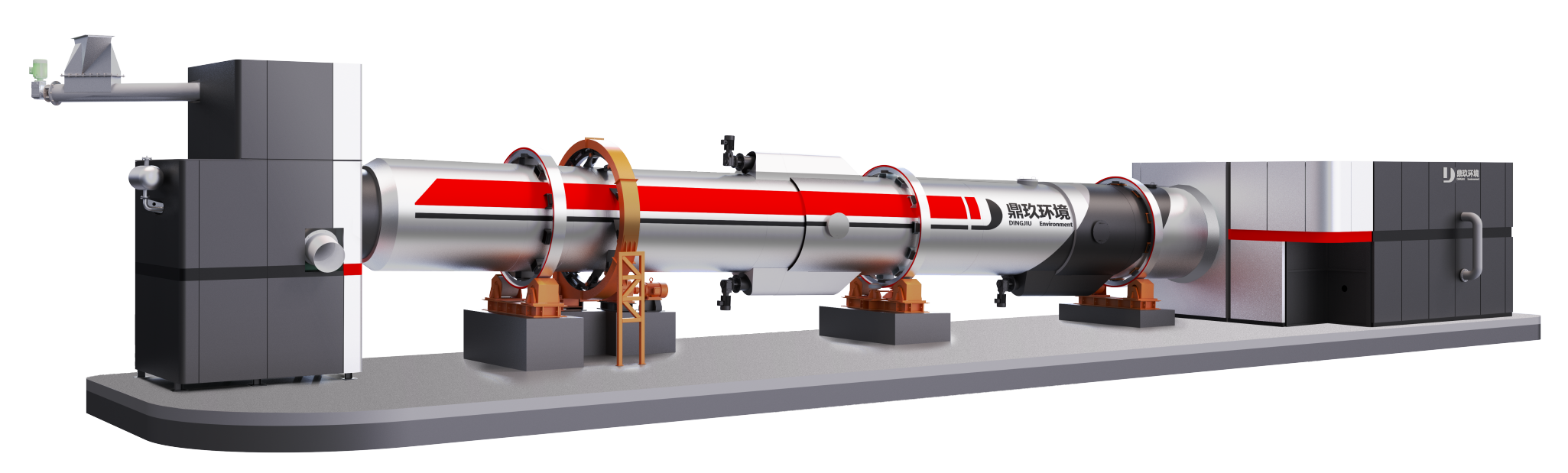
Integrated Continuous Sludge Drying and Carbonization Machine
VII. Outlook
Sludge carbonization, as a thermochemical treatment alternative to sludge incineration, shows significant advantages in sludge energy utilization, resource recovery, pollutant control, and greenhouse gas emission reduction. It is an important pathway to realize sludge resource recovery and low-carbon treatment. Its large-scale application needs to overcome bottlenecks such as cost, standards, and market acceptance. In the future, with process innovation and stronger policy support, this technology is expected to gain a larger share in the municipal and industrial sludge treatment fields, contributing to the development of the circular economy and the achievement of carbon neutrality goals.Hunan Dingjiu was founded in 2016, with its headquarters in Changsha, Hunan Province. It is a national high-tech enterprise and a governing member of the Sludge Treatment Branch of the China Environmental Protection Industry Association.The company's shareholders include the inventor of the "integrated sludge continuous drying and carbonization technology" and a state-owned listed enterprise.The company has filed over 40 invention patents in the field of pyrolysis of organic solid waste, with 23 granted, and holds 5 international PCT patents and several software copyrights.The company is dedicated to the research and development of sludge and solid waste resource recovery technologies and equipment manufacturing, with business covering engineering design, equipment supply, and operation services, striving to become a global leader in the future development of sludge carbonization technology.
Contact number:0731-81876331
Email address:info@hndjhj.com
Website: https://www.hndjhj.com/



0 Comments
Post comment